Feishu
Feishu/Lark 是一个一站式协作平台,团队可以在其中聊天、共享文档、管理日历并协同完成工作。
状态: 机器人私信 + 群聊已可用于生产环境。WebSocket 是默认模式;webhook 模式为可选。
运行渠道设置向导
bash openclaw channels login --channel feishu选择手动设置以粘贴来自飞书开放平台的 App ID 和 App Secret,或者选择二维码设置以自动创建机器人。如果国内版飞书移动应用无法响应二维码,请重新运行设置并选择手动设置。设置完成后,重启网关以应用更改
bash openclaw gateway restart
配置 dmPolicy 以控制谁可以给机器人发送 :
"pairing"- 未知用户会收到配对码;通过 CLI 批准"allowlist"- 只有allowFrom中列出的用户可以聊天(默认:仅机器人所有者)"open"- 仅当allowFrom包含"*"时才允许公开 ;如果有限制性条目,则只有匹配的用户可以聊天"disabled"- 禁用所有
批准配对请求:
openclaw pairing list feishuopenclaw pairing approve feishu### 群聊
**群组策略** (`channels.feishu.groupPolicy`):
| 值 | 行为 || ------------- | ------------------------------------------------------------------------ || `"open"` | 响应群组中的所有消息 || `"allowlist"` | 仅响应 `groupAllowFrom` 中的群组或在 `groups.
下显式配置的群组 | |”disabled” | 禁用所有群组消息;显式的groups.
` 条目不会覆盖此项 |
默认值:allowlist
提及要求 (channels.feishu.requireMention):
true - 需要 @提及(默认)false - 无需 @提及即可响应- 按群组覆盖:`channels.feishu.groups.
.requireMention`
- 仅广播
@all 和 @_all 不被视为对机器人的提及。即使消息同时提及了 @all 和直接提及了机器人,仍然算作对机器人的提及。
群组配置示例
Section titled “群组配置示例”
允许所有群组,不需要 @提及
Section titled “允许所有群组,不需要 @提及”
{ channels: { feishu: { groupPolicy: "open", }, },}
允许所有群组,仍需 @提及
Section titled “允许所有群组,仍需 @提及”
{ channels: { feishu: { groupPolicy: "open", requireMention: true, }, },}
仅允许特定群组
Section titled “仅允许特定群组”
{ channels: { feishu: { groupPolicy: "allowlist", // Group IDs look like: oc_xxx groupAllowFrom: ["oc_xxx", "oc_yyy"], }, },}
在 allowlist 模式下,您还可以通过添加显式的 `groups.
条目来允许特定群组。显式条目不会覆盖groupPolicy: “disabled”。groups.*` 下的通配符默认值用于配置匹配的群组,但它们本身不足以允许群组。
{ channels: { feishu: { groupPolicy: "allowlist", groups: { oc_xxx: { requireMention: false, }, }, }, },}
限制群组内的发送者
Section titled “限制群组内的发送者”
{ channels: { feishu: { groupPolicy: "allowlist", groupAllowFrom: ["oc_xxx"], groups: { oc_xxx: { // User open_ids look like: ou_xxx allowFrom: ["ou_user1", "ou_user2"], }, }, }, },}
获取群组/用户 ID
Section titled “获取群组/用户 ID”
群组 ID (chat_id,格式:oc_xxx)
Section titled “群组 ID (chat_id,格式:oc_xxx)”
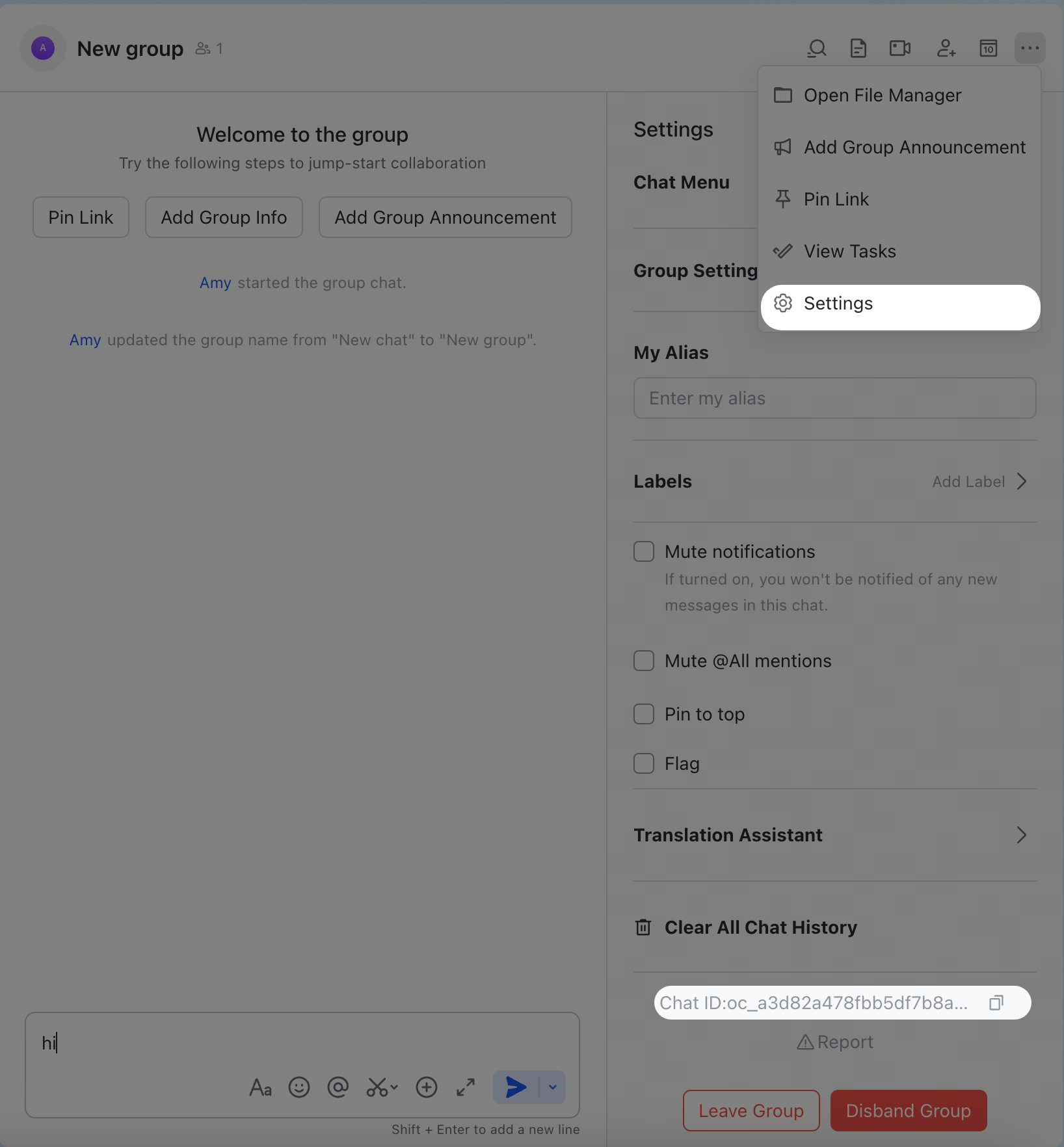
在飞书/Lark 中打开群组,点击右上角的菜单图标,然后进入 Settings(设置)。群组 ID (chat_id) 列在设置页面上。
用户 ID (open_id,格式:ou_xxx)
Section titled “用户 ID (open_id,格式:ou_xxx)”
启动网关,向机器人发送一条私信,然后检查日志:
Terminal window openclaw logs --follow
在日志输出中查找 open_id。您也可以检查待处理的配对请求:
Terminal window openclaw pairing list feishu
命令 描述 /status显示机器人状态 /reset重置当前会话 /model显示或切换 AI 模型
机器人在群聊中无响应
Section titled “机器人在群聊中无响应”
- 确保机器人已添加到群组中
- 确保您 @提及 了机器人(默认情况下需要)
- 验证
groupPolicy 不是 "disabled"
- 检查日志:
openclaw logs --follow
机器人未收到消息
Section titled “机器人未收到消息”
- 确保机器人已在飞书开放平台 / Lark Developer 中发布并审核通过
- 确保事件订阅包含
im.message.receive_v1
- 确保选择了 持久连接 (WebSocket)
- 确保已授予所有必需的权限范围
- 确保网关正在运行:
openclaw gateway status
- 检查日志:
openclaw logs --follow
飞书移动应用中二维码设置无反应
Section titled “飞书移动应用中二维码设置无反应”
- 重新运行设置:
openclaw channels login --channel feishu
- 选择手动设置
- 在飞书开放平台中,创建一个自建应用并复制其 App ID 和 App Secret
- 将这些凭据粘贴到设置向导中
App Secret 泄露
Section titled “App Secret 泄露”
- 在飞书开放平台 / Lark Developer 中重置 App Secret
- 更新配置中的值
- 重启网关:
openclaw gateway restart
{ channels: { feishu: { defaultAccount: "main", accounts: { main: { appId: "cli_xxx", appSecret: "xxx", name: "Primary bot", tts: { providers: { openai: { voice: "shimmer" }, }, }, }, backup: { appId: "cli_yyy", appSecret: "yyy", name: "Backup bot", enabled: false, }, }, }, },}
defaultAccount 控制当出站 API 未指定 accountId 时使用哪个账号。
`accounts.
.tts使用与messages.tts` 相同的结构,并与全局 TTS 配置进行深度合并,因此多机器人飞书设置可以在全局保留共享提供商凭据,同时仅为每个账号覆盖语音、模型、人格或自动模式。
textChunkLimit - 出站文本块大小(默认:2000 字符)mediaMaxMb - 媒体上传/下载限制(默认:30 MB)
飞书/Lark 支持通过交互式卡片进行流式回复。启用后,机器人会在生成文本时实时更新卡片。
{ channels: { feishu: { streaming: true, // enable streaming card output (default: true) blockStreaming: true, // opt into completed-block streaming }, },}
设置 streaming: false 以在一条消息中发送完整回复。blockStreaming 默认关闭;仅当您希望在最终回复之前刷新已完成的助手块时才启用它。
通过两个可选标志减少飞书/Lark API 调用的次数:
typingIndicator(默认 true):设置 false 以跳过正在输入的反应调用resolveSenderNames(默认 true):设置 false 以跳过发送者资料查找
{ channels: { feishu: { typingIndicator: false, resolveSenderNames: false, }, },}
ACP 会话
Section titled “ACP 会话”
飞书/Lark 支持私信和群组线程消息的 ACP。飞书/Lark ACP 由文本命令驱动 - 没有原生斜杠命令菜单,因此请直接在对话中使用 /acp ... 消息。
持久化 ACP 绑定
Section titled “持久化 ACP 绑定”
{ agents: { list: [ { id: "codex", runtime: { type: "acp", acp: { agent: "codex", backend: "acpx", mode: "persistent", cwd: "/workspace/openclaw", }, }, }, ], }, bindings: [ { type: "acp", agentId: "codex", match: { channel: "feishu", accountId: "default", peer: { kind: "direct", id: "ou_1234567890" }, }, }, { type: "acp", agentId: "codex", match: { channel: "feishu", accountId: "default", peer: { kind: "group", id: "oc_group_chat:topic:om_topic_root" }, }, acp: { label: "codex-feishu-topic" }, }, ],}
从聊天启动 ACP
Section titled “从聊天启动 ACP”
在飞书/Lark 私信或线程中:
/acp spawn codex --thread here
--thread here 适用于私信和飞书/Lark 线程消息。绑定对话中的后续消息直接路由到该 ACP 会话。
多智能体路由
Section titled “多智能体路由”
使用 bindings 将飞书/Lark 私信或群组路由到不同的 Agent。
{ agents: { list: [{ id: "main" }, { id: "agent-a", workspace: "/home/user/agent-a" }, { id: "agent-b", workspace: "/home/user/agent-b" }], }, bindings: [ { agentId: "agent-a", match: { channel: "feishu", peer: { kind: "direct", id: "ou_xxx" }, }, }, { agentId: "agent-b", match: { channel: "feishu", peer: { kind: "group", id: "oc_zzz" }, }, }, ],}
路由字段:
match.channel:"feishu"match.peer.kind:"direct"(私信)或 "group"(群聊)match.peer.id:用户 Open ID(ou_xxx)或群组 ID(oc_xxx)
有关查找提示,请参阅 获取群组/用户 ID。
每用户 Agent 隔离(动态 Agent 创建)
Section titled “每用户 Agent 隔离(动态 Agent 创建)”
启用 dynamicAgentCreation 可自动为每个私信用户创建隔离的 Agent 实例。每个用户获得自己的:
- 独立的工作区目录
- 单独的
USER.md / SOUL.md / MEMORY.md
- 私有的对话历史记录
- 隔离的技能和状态
对于希望每个用户都拥有自己的私人 AI 助手体验的公共机器人来说,这一点至关重要。
{ channels: { feishu: { dmPolicy: "open", allowFrom: ["*"], dynamicAgentCreation: { enabled: true, workspaceTemplate: "~/.openclaw/workspace-{agentId}", agentDirTemplate: "~/.openclaw/agents/{agentId}/agent", }, }, }, session: { // Critical: makes each user's DM their "main session" // Automatically loads USER.md / SOUL.md / MEMORY.md // For stronger isolation, use "per-channel-peer" instead dmScope: "main", },}
当新用户发送其第一条私信时:
- 渠道生成一个唯一的
agentId = feishu-{user_open_id}
- 在
workspaceTemplate 路径下创建一个新的工作区
- 注册代理并为该用户创建绑定
- 工作区助手确保在首次访问时引导文件(
AGENTS.md、SOUL.md、USER.md 等)
- 将来自该用户的所有后续消息路由到其专用代理
设置 描述 默认值 channels.feishu.dynamicAgentCreation.enabled启用自动按用户创建代理 falsechannels.feishu.dynamicAgentCreation.workspaceTemplate动态代理工作区的路径模板 ~/.openclaw/workspace-{agentId}channels.feishu.dynamicAgentCreation.agentDirTemplate代理目录名称模板 ~/.openclaw/agents/{agentId}/agentchannels.feishu.dynamicAgentCreation.maxAgents要创建的动态代理的最大数量 无限制
模板变量:
{agentId} - 生成的代理 ID(例如 feishu-ou_xxxxxx){userId} - 发送者的飞书 open_id(例如 ou_xxxxxx)
session.dmScope 控制如何将私信映射到代理会话。这是一个影响所有渠道的全局设置。
值 行为 最适用于 "main"每个用户的私信映射到其代理的主会话 您希望 USER.md / SOUL.md 自动加载的单用户机器人 "per-channel-peer"每个(渠道 + 用户)组合都有一个单独的会话 需要更强隔离的公共多用户机器人
权衡:使用 "main" 可以启用引导文件的自动加载(USER.md、SOUL.md、MEMORY.md),但这意味着所有渠道的所有私信都共享相同的会话密钥模式。对于隔离性比引导文件自动加载更重要的公共多用户机器人,请考虑使用 "per-channel-peer" 并手动管理引导文件。
{ session: { // For single-user personal bots: enables auto bootstrap loading dmScope: "main",
// For public multi-user bots: stronger isolation // dmScope: "per-channel-peer", },}
典型的多用户部署
Section titled “典型的多用户部署”
{ channels: { feishu: { appId: "cli_xxx", appSecret: "xxx", dmPolicy: "open", allowFrom: ["*"], groupPolicy: "open", requireMention: true, dynamicAgentCreation: { enabled: true, workspaceTemplate: "~/.openclaw/workspace-{agentId}", agentDirTemplate: "~/.openclaw/agents/{agentId}/agent", }, }, }, session: { // Choose dmScope based on your isolation needs: // "main" for bootstrap auto-loading, "per-channel-peer" for stronger isolation dmScope: "main", }, bindings: [], // Empty - dynamic agents auto-bind}
检查 Gateway(网关) 日志以确认动态创建是否正常工作:
feishu: creating dynamic agent "feishu-ou_xxxxxx" for user ou_xxxxxxworkspace: /Users/you/.openclaw/workspace-feishu-ou_xxxxxxfeishu: dynamic agent created, new route: agent:feishu-ou_xxxxxx:main
列出所有已创建的工作区:
Terminal window ls -la ~/.openclaw/workspace-*
- 工作区隔离:每个用户都有自己的工作区目录和代理实例。在正常消息流中,用户无法看到彼此的对话历史或文件。
- 安全边界:这是一种消息上下文隔离机制,而非针对恶意租户的安全边界。代理进程和主机环境是共享的。
bindings 应为空:动态代理会自动注册其自身的绑定- 升级路径:现有的手动绑定将继续与动态代理一起工作
session.dmScope 是全局的:这会影响所有渠道,而不仅仅是飞书
完整配置:[Gateway(网关) 配置](
)
设置 描述 默认值 channels.feishu.enabled启用/禁用该渠道 truechannels.feishu.domainAPI 域名(APIfeishu 或 lark) feishuchannels.feishu.connectionMode事件传输方式(websocket 或 webhook) websocketchannels.feishu.defaultAccount出站路由的默认账号 defaultchannels.feishu.verificationTokenWebhook 模式所需 - channels.feishu.encryptKeyWebhook 模式所必需 - channels.feishu.webhookPathWebhook 路由路径 /feishu/eventschannels.feishu.webhookHostWebhook 绑定主机 127.0.0.1channels.feishu.webhookPortWebhook 绑定端口 3000`channels.feishu.accounts.
.appId | App ID | - | |channels.feishu.accounts.
.appSecret | App Secret | - | |channels.feishu.accounts.
.domain | 每个账号的域名覆盖 |feishu | |channels.feishu.accounts.
.tts | 每个账号的 TTS 覆盖 |messages.tts | |channels.feishu.dmPolicy | 私信策略 |allowlist | |channels.feishu.allowFrom | 私信白名单(open_id 列表) | [BotOwnerId] | |channels.feishu.groupPolicy | 群组策略 |allowlist | |channels.feishu.groupAllowFrom | 群组白名单 | - | |channels.feishu.requireMention | 在群组中要求 @提及 |true | |channels.feishu.groups.
.requireMention | 每个群组的 @提及覆盖;在白名单模式下,显式 ID 也会允许该群组 | inherited | |channels.feishu.groups.
.enabled | 启用/禁用特定群组 |true | |channels.feishu.dynamicAgentCreation.enabled | 启用自动创建每个用户的代理 |false | |channels.feishu.dynamicAgentCreation.workspaceTemplate| 动态代理工作空间的路径模板 |/.openclaw/workspace-{agentId} | |channels.feishu.dynamicAgentCreation.agentDirTemplate | 代理目录名称模板 |/.openclaw/agents/{agentId}/agent| |channels.feishu.dynamicAgentCreation.maxAgents | 要创建的动态代理的最大数量 | unlimited | |channels.feishu.textChunkLimit | 消息分块大小 |2000 | |channels.feishu.mediaMaxMb | 媒体大小限制 |30 | |channels.feishu.streaming | 流式卡片输出 |true | |channels.feishu.blockStreaming | 已完成块回复流式传输 |false | |channels.feishu.typingIndicator | 发送正在输入反应 |true | |channels.feishu.resolveSenderNames | 解析发送者显示名称 |true | |channels.feishu.tools.bitable | 启用 Bitable/Base 工具 |true | |channels.feishu.tools.base |channels.feishu.tools.bitable的别名;如果两者均已设置,则显式的bitable优先 |true | |channels.feishu.accounts.
.tools.bitable | 每个账户的 Bitable/Base 工具开关 | inherited | |channels.feishu.accounts.
.tools.base |tools.bitable` 的每个账户的别名 | inherited |
支持的消息类型
Section titled “支持的消息类型”
- ✅ 文本
- ✅ 富文本(帖子)
- ✅ 图片
- ✅ 文件
- ✅ 音频
- ✅ 视频/媒体
- ✅ 表情包
入站的飞书/Lark 音频消息被规范化为媒体占位符,而不是原始 file_key JSON。当配置了 tools.media.audioOpenClaw 时,OpenClaw 会下载语音消息资源并在智能体回合之前运行共享的音频转录,因此智能体会接收口语转录文本。如果飞书直接在音频负载中包含转录文本,则使用该文本而无需再次调用 ASR。如果没有音频转录提供商,智能体仍然会收到 `
` 占位符以及保存的附件,而不是原始的飞书资源负载。
- ✅ 文本
- ✅ 图片
- ✅ 文件
- ✅ 音频
- ✅ 视频/媒体
- ✅ 交互式卡片(包括流式更新)
- ⚠️ 富文本(帖子样式格式;不支持完整的飞书/Lark 创作功能)
飞书/Lark 原生语音气泡使用飞书 audio 消息类型,并要求
上传 Ogg/Opus 媒体 (file_type: "opus")。现有的 .opus 和 .ogg 媒体
将作为原生音频直接发送。MP3/WAV/M4A 和其他常见音频格式
仅在回复请求语音传递 (audioAsVoice / 消息工具 asVoice,包括 TTS 语音笔记
回复) 时,才会通过 ffmpeg 转码为 48kHz Ogg/Opus。普通的 MP3 附件保持为常规文件。如果 ffmpegOpenClaw 缺失或
转换失败,OpenClaw 将回退到文件附件并记录原因。
- ✅ 内联回复
- ✅ 串回复
- ✅ 回复串消息时,媒体回复保持串上下文感知
对于 groupSessionScope: "group_topic" 和 "group_topic_sender",飞书/Lark 原生
话题组使用事件 thread_id (omt_*) 作为规范的话题会话密钥。如果原生话题发起事件省略了 thread_idOpenClawOpenClaw,OpenClaw
会在路由该轮次之前从飞书中获取它。OpenClaw 转换为串的普通群组回复继续使用回复根消息 ID (om_*),这样
第一轮和后续轮次就会保持在同一会话中。
- Channels Overview - 所有支持的渠道
- Pairing - 私信认证和配对流程
- Groups - 群聊行为和提及控制
- Channel Routing - 消息的会话路由
- Security - 访问模型和安全加固